The Relational Defense Lab
Decoding Dark Patterns. Building Relational Immunity.
The Relational Defense Lab is the research division of The Healthy Relationship Lab dedicated to a single mission: exposing the hidden mechanisms of psychological manipulation and equipping people with the tools to neutralize them. While most approaches focus on recovery after the damage is done, we focus on prevention and real-time detection teaching you to recognize manipulation the moment it happens, not months later.

Why Prevention Matters More Than Recovery
Traditional approaches to toxic relationships wait until after the harm has occurred. The Relational Defense Lab takes a fundamentally different stance: the most powerful intervention is the one that never lets manipulation take root in the first place.
The Conventional Approach
Most educational models address psychological manipulation after the fact after trust has been broken, self-esteem eroded, and patterns have calcified over months or years. Recovery is real and valuable, but it is slow, painful, and incomplete.
- Focuses on addressing patterns already formed
- Relies on retrospective pattern recognition
- Requires extensive time and support
- Does not prevent future exposure
The Relational Defense Lab Approach
We study the specific tactics manipulators use their neurological triggers, emotional levers, and behavioral sequences and we translate that research into practical detection and response skills you can deploy in real time, in any relationship.
- Real-time recognition of manipulation as it unfolds
- Evidence-based frameworks for in-the-moment response
- Neurological grounding to prevent emotional overwhelm
- Lasting relational immunity through identity anchoring
The 5 Core Manipulation Patterns
Every manipulative relationship, regardless of its surface complexity, tends to rely on a predictable set of core tactics. Understanding them in precise, behavioral detail is the first step toward immunity.

Gaslighting
A systematic undermining of your perception of reality. The manipulator introduces subtle contradictions, denies events you witnessed, and reframes your emotional responses as irrational until you begin to trust their version of events over your own lived experience.

Guilt Induction
Emotional blackmail perfected. Guilt induction converts your empathy into a mechanism of control. The manipulator cultivates a chronic sense of obligation and unworthiness, ensuring you remain compliant to avoid the unbearable feeling of having caused harm.

Silent Treatment
Absence weaponized. By withdrawing communication and presence, the manipulator creates a vacuum of anxiety that compels you to seek reconciliation on their terms rewarding their silence with your capitulation, again and again.

Love Bombing
The illusion of perfect love. An overwhelming early flood of affection, attention, and idealization that creates rapid emotional dependency making the subsequent withdrawal and control feel all the more devastating by contrast.

DARVO
Deny, Attack, Reverse Victim and Offender. When confronted, the manipulator denies wrongdoing, attacks the person raising concerns, and reframes themselves as the true victim leaving the actual victim confused, discredited, and apologizing.
The 5 Influence Principles Weaponized by Manipulators
Rooted in Cialdini's foundational research on social influence, these principles are ethically neutral by nature but in the hands of a manipulator, each becomes a precisely calibrated instrument of control. Understanding the mechanism is the antidote.
1. Reciprocity
Unsolicited favors and gifts create a felt obligation to return the gesture even when the "gift" was never wanted and the "debt" is manufactured. Manipulators give strategically to collect compliance later.
2. Consistency and Commitment
Once a person makes a small concession or public commitment, psychological pressure builds to remain consistent with that position. Manipulators engineer incremental agreements that escalate toward larger compliance over time.
3. Social Proof
"Everyone agrees with me you're the only one who sees it differently." Manufactured consensus isolates the target and undermines their confidence in their own perception, making them more susceptible to the manipulator's narrative.
4. Authority
Claimed expertise, status, or social position is leveraged to override the target's independent judgment. Credentials real or fabricated silence dissent by making disagreement feel presumptuous or dangerous.
5. Scarcity
"This is your last chance." Artificial urgency and the threat of irreversible loss short-circuit deliberate reasoning and push the target into panicked, compliance-driven decisions that serve the manipulator's agenda.
The Neuroscience Behind Manipulation
Manipulation is not simply a social phenomenon it is a neurological vulnerability. Understanding the brain's threat-detection architecture explains why intelligent, self-aware people can find themselves trapped in manipulative dynamics despite every rational signal telling them to leave.
How the Limbic System Gets Hijacked
The limbic system particularly the amygdala operates as the brain's primary threat-detection circuit. When this system perceives emotional danger (rejection, abandonment, humiliation), it triggers a fear response that bypasses prefrontal cortical reasoning entirely. The thinking brain goes offline. The survival brain takes over.
Skilled manipulators intuitively or deliberately exploit this architecture. By maintaining a chronic undercurrent of unpredictability, emotional threat, and intermittent reward, they keep their target's emotional state in a perpetual state of alertness. In this state, the target's mental resources are consumed by threat-management rather than clear evaluation of what is actually happening.
Why Rational Advice Doesn't Work
This neurological reality explains why well-meaning friends who say "just leave" or "can't you see what they're doing?" often fail to help. The target already knows, intellectually, that something is wrong. But the limbic system does not respond to logic it responds to felt safety.
True relational immunity requires developing the capacity to remain emotionally regulated under pressure, so that the prefrontal cortex stays online long enough to recognize manipulation in real time and execute a deliberate response rather than a reactive one.
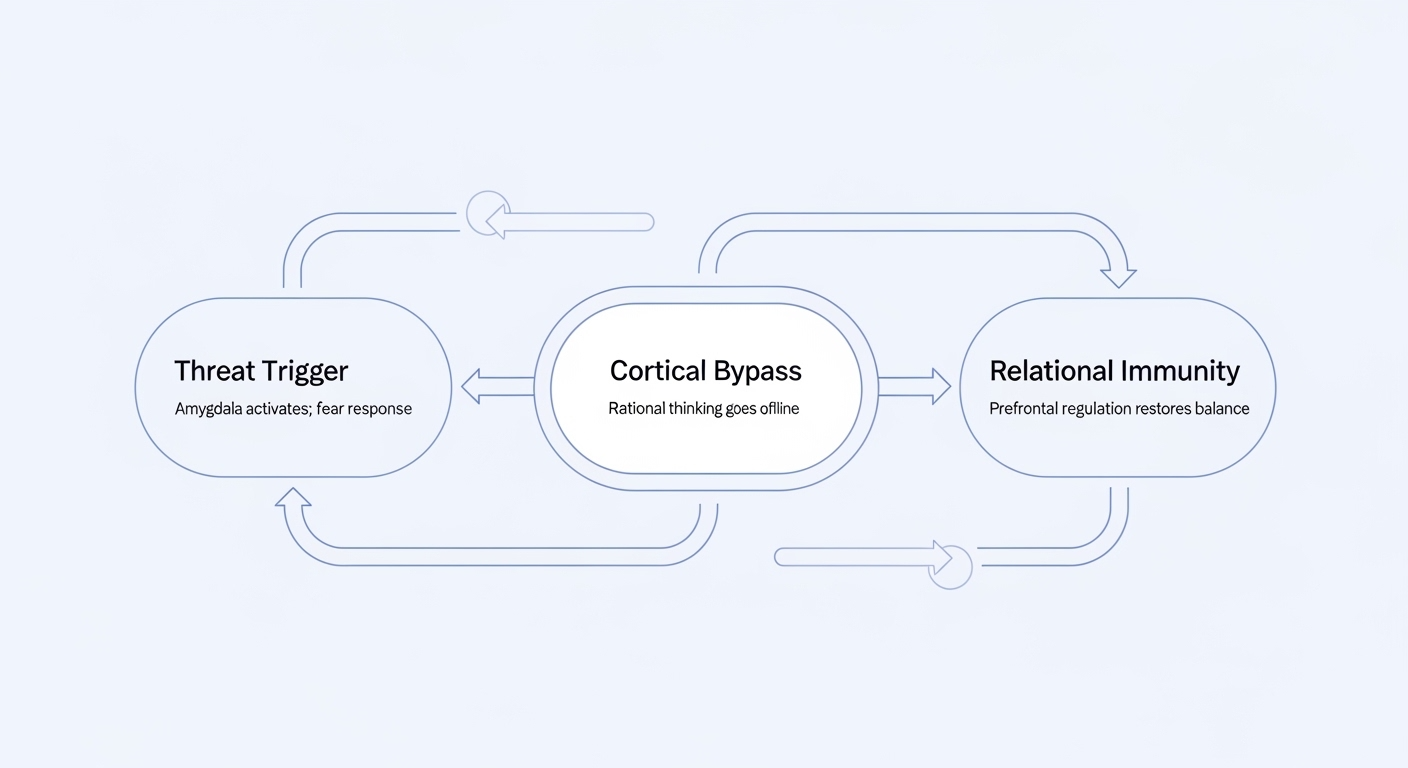
The Relational Defense Lab's frameworks are specifically designed to interrupt this sequence restoring rational agency at the moment it is most needed.
The A-C-R Framework
Autonomy · Competence · Relationship
Drawn from Self-Determination Theory one of the most rigorously validated frameworks in motivational psychology the A-C-R Framework provides a real-time diagnostic for evaluating relational health. At any moment, in any relationship, you can ask three questions that will reveal whether the dynamic is nourishing or eroding you.
Autonomy
Does this relationship support your right to make choices that reflect your own values, needs, and identity or does it systematically undermine, override, or punish your independent judgment?
Healthy relationships expand your sense of agency. Manipulative ones contract it gradually, and often imperceptibly.
Competence
Does this relationship affirm your capacity to navigate challenges, trust your perceptions, and grow in your abilities or does it cultivate chronic self-doubt, dependence, and a felt sense of inadequacy?
Gaslighting and guilt induction specifically target the competence dimension, eroding self-trust at the root.
Relationship
Does this relationship generate genuine feelings of being known, valued, and securely connected or does it produce chronic anxiety, isolation, and the exhausting effort of managing another person's emotional state?
Love bombing exploits the relationship dimension by simulating deep connection before it has been genuinely earned.
When all three dimensions are consistently supported, a relationship is growth-generating. When one or more is systematically undermined, the A-C-R scan surfaces the pattern providing a language for what your inner awareness already signals.
The P.C.T. Framework
Process - Content - Time
Emotional conflicts rarely resolve because the people in them are arguing about completely different things without realizing it. The P.C.T. Framework provides a three-dimensional map for navigating difficult conversations with precision separating what is actually happening from what appears to be happening.

Process
How are we communicating right now? Are we in a regulated, collaborative state, or are we in threat-response mode, where winning matters more than understanding? Process is the container for all content. If the process is broken, no amount of "right words" will resolve the conflict.

Content
What is the actual subject of this conversation? Skilled manipulators constantly shift content introducing new grievances, reversals, and tangential accusations to prevent any single issue from ever reaching resolution. Naming the content and holding it fixed is an act of relational discipline.

Time
When are we? Are we addressing a present issue, or has this conversation collapsed into a referendum on the entire history of the relationship? Time-binding a conflict, committing to discuss one specific incident at a time is one of the most powerful de-escalation tools available.
In Practice: Before engaging in any high-stakes conversation, run a P.C.T. check. Are both people regulated enough to engage the content? Has the content been clearly identified and agreed upon? Is the conversation anchored in a specific, bounded time frame? If any dimension is misaligned, address that first before attempting to resolve the stated issue.
The S.A.G.E. Framework
The S.A.G.E. Framework Support · Alternatives · Generous · Ethical
Most boundary-setting fails not because the boundary was wrong, but because it was communicated in a way that triggered defensiveness, shame, or retaliation. The S.A.G.E. Framework solves this problem by teaching boundaries that unite rather than isolate protecting your integrity while preserving the relational fabric wherever that is genuinely possible.

Support
Communicate your boundary from a position of care for the relationship, not rejection of the person. "I want us to work well together, which is why I need to address this" establishes a collaborative rather than adversarial frame reducing the other person's need to defend or retaliate.

Alternatives
Where possible, offer a workable alternative to the behavior you are limiting. This signals that you are not simply withholding you are redirecting toward something that works for both parties. It also makes the boundary feel less like a punishment and more like a negotiation in good faith.

Generous
Assume the most charitable available interpretation of the other person's behavior before setting the boundary. This is not naivety it is strategic. A generous framing disarms defensiveness and increases the likelihood that the boundary will be heard and respected rather than fought.

Ethical
Your boundary must be rooted in your values not in retaliation, punishment, or the desire to control the other person's behavior. An ethical boundary protects your integrity while honoring the other person's dignity. It is a statement about what you will and will not participate in, not a demand for who they must be.
Response Strategies for Each Manipulation Pattern
Knowledge of manipulation tactics is necessary but not sufficient. The Relational Defense Lab provides specific, scripted response strategies for each of the five core patterns, so that when the moment arrives, you have language ready and your emotional state is not starting from zero.
Against Gaslighting
Anchor to documented reality. Keep records. Use neutral, factual language: "I experienced it this way. I understand you see it differently. I'm not asking you to agree I'm telling you what I experienced." Refuse to debate your own perceptions. Bring in trusted third-party witnesses when patterns repeat.
Against Guilt Induction
Separate empathy from compliance. You can acknowledge someone's pain without accepting responsibility for it: "I can see you're hurting, and I care about that. And I'm still not going to change my decision." Guilt induction collapses these two responses your job is to hold them distinct.
Against Silent Treatment
Name the pattern without chasing it: "I notice you've stopped communicating. I'm here when you're ready to talk. I'm not going to pursue the conversation while it's being withheld." Refusing to chase restores power balance without escalating conflict.
Against Love Bombing
Slow the pace deliberately. Genuine connection deepens over time it does not arrive fully formed in week two. Trust is built through consistent behavior across varied circumstances, not through intensity of feeling in ideal conditions. Use time as your diagnostic tool.
Against DARVO
Hold the original subject with precision: "I hear that you're feeling hurt by how I raised this. I'd like to address that. And I want us to also return to the original concern, because both matter." Refuse to allow the reversal to erase the initial issue from the conversation.
"Relational immunity is not about becoming cold or suspicious. It is about becoming so grounded in your own identity that no one can destabilize you." — Daniel Hartman

The Healthy Relationship Movement
From Individual Growth to Collective Transformation
The Healthy Relationship Lab is not just a program. It is the beginning of a movement one grounded in the conviction that relational intelligence is the most consequential and most neglected skill of our time.

The Research Case for Relational Intelligence
For too long, relational intelligence has been classified as a "soft skill" something pleasant to develop but peripheral to real achievement. The empirical record tells a profoundly different story.
80%
Success Depends on People Skills
Harvard, Stanford, and Carnegie Foundation research consistently shows that 85% of long-term professional and personal success is driven by communication, emotional, and relational abilities not technical knowledge.
80
Years of Harvard Research
1The Harvard Study of Adult Development the longest-running study of adult life ever conducted tracked participants for eight decades and reached one unambiguous conclusion.
~0
Hours Taught in Schools
Despite the research consensus, virtually zero formal education hours are dedicated to teaching people ho1w to communicate without destroying, set boundaries without isolating, or connect without losing themselves.
The Harvard Study of Adult Development concluded that the single strongest predictor of a happy, healthy, and long life is not wealth, career success, or genetics. It is the quality of your relationships.
This is not a peripheral finding. It is the central finding of the most comprehensive longitudinal study of human flourishing ever undertaken and it demands a fundamental reordering of what we consider essential knowledge.
The Vision: A World Built on Relational Intelligence
That is what this movement exists to change. The Healthy Relationship Movement is built around a clear and ambitious vision for what becomes possible when relational intelligence is treated as the foundational human skill it has always been.

Emotional Literacy as Core Curriculum
A world where emotional literacy is taught alongside mathematics with equal rigor, equal resources, and equal cultural prestige. Where children learn to recognize and regulate their own emotional states before those states shape decades of unconscious behavioral patterns.

Breaking Inherited Patterns
A world where people stop being unconsciously shaped by inherited relational patterns the family dynamics, cultural scripts, and survival strategies absorbed in childhood and become conscious architects of entirely new ways of connecting.

Relationships as Real Capital
A world that recognizes authentic relationships as its primary generative resource the infrastructure of trust, innovation, resilience, and meaning that no technology, economic system, or institution can manufacture from the outside.
What We Believe
Every movement is sustained by a set of foundational convictions beliefs that orient action when the path is unclear. These are ours.
Every person carries both wounds and gifts.
Growth is not about erasing the past it is about unlocking the extraordinary potential hidden within it. The most challenging chapters of a life, when processed with skill and support, often become the source of its deepest wisdom and most genuine compassion.
Authentic relationships are your real capital.
They generate trust, open unexpected doors, and provide unshakable support in the most difficult moments. Money can open a door. Only authentic relationships keep it open for life. The return on investment from genuine human connection compounds in ways no financial instrument can replicate.
Fear and love are the two primary operating systems of the human brain.
You were not born knowing which one would run your life that was shaped by circumstance, experience, and the relationships you were given before you were old enough to choose. But you can learn, at any point, to consciously choose which operating system governs your decisions, your communication, and your sense of self.
The transformation is not individual, it is relational and systemic.
When one person in a system changes, the entire system shifts. One conscious creator of healthy relationships ripples outward into every family, every team, every community they touch. This is not metaphor. It is the empirically documented mechanism of social change.
"Money can open a door. Only authentic relationships keep it open for life."
Join the Movement
This work begins with one decision: to stop treating relational intelligence as optional. To recognize that how you connect, communicate, and protect yourself in relationships is not a peripheral life skill it is the central one. The research is clear. The frameworks are here. The only thing left is the choice to begin.
🔬 For Researchers
Bring the Relational Defense Lab's tools into your research or educational work.
📚 For Informed Readers
Develop the vocabulary, awareness, and practical skills to recognize manipulation in real time, communicate with precision under emotional pressure, and build relationships that genuinely nourish and protect.
🌍 For Movement Builders
Join a growing community of conscious creators who understand that when one person transforms their relational patterns, the ripple reaches every family, team, and community they touch. Be the change in your system.
DISCLAIMER — Implementation Instructions
"The Healthy Relationship Lab content is for educational purposes only and does not constitute psychological, medical, or therapeutic advice. Daniel Hartman is not a licensed mental health professional. For clinical support please consult a licensed professional."
Read Full Disclaimer →The Healthy Relationship Lab
Neuroscience-based education for authentic relationships.
All payments are processed securely by Paddle.com Market Ltd., Merchant of Record.
© 2026 The Healthy Relationship Lab · Privacy Policy · Terms of Use · Disclaimer · Contact